
Constant current source
7805
Pinout
| Pin | Function |
|---|---|
| IN | Unregulated input voltage. |
| GND | Common terminal and reference for the 5 V output. In this application it is the node through which the current flows out to the load. |
| OUT | Regulated output, 5 V above GND. |
MC7805
The 7805 (here in its MC7805 version) is a three-terminal linear voltage regulator from the well-known 78xx family. It delivers a fixed 5 V output at up to 1 A with adequate heat sinking. It usually comes in a TO-220 package.
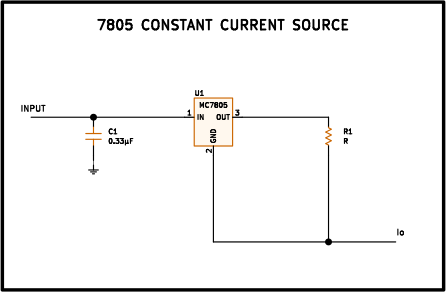
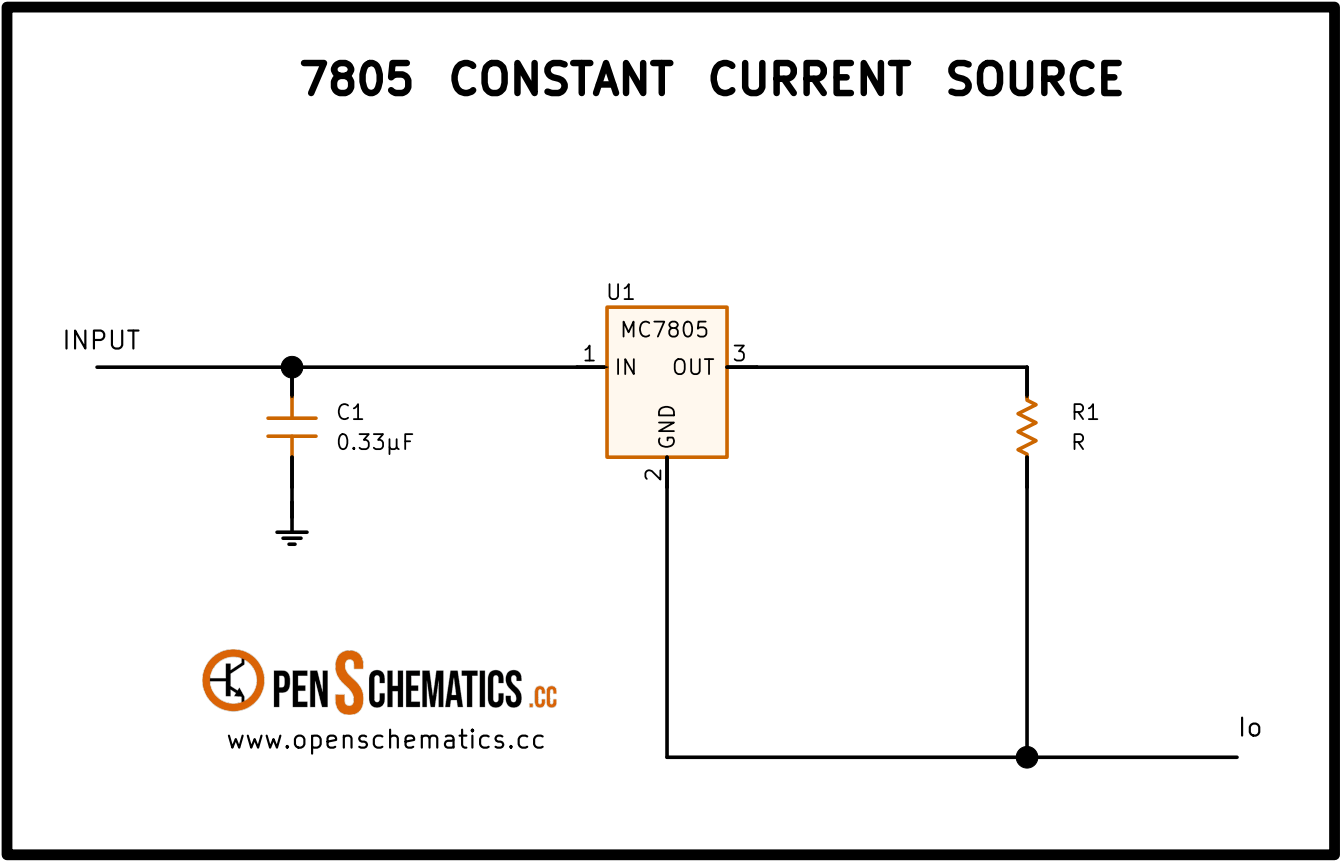
Although its most common use is as a voltage regulator, the very same part works as a constant current source by simply adding a resistor, as the schematic shows.
How the circuit works
The key is the regulator’s fundamental property: it always keeps 5 V between its output pin (OUT) and its common pin (GND), regardless (within its limits) of what is connected.
If we place a resistor R between OUT and GND, the regulator itself ensures the voltage across it is exactly 5 V. By Ohm’s law, the current through it is set by that voltage and that resistance, and is practically independent of the load: no matter what we connect in series at the output, the regulator adjusts its output voltage to keep those 5 V across R and, with them, the current.
That current flows out of the GND pin toward the load. The input capacitor C1 improves stability and filters supply noise, just as in a conventional regulator.
Application design
The output current follows directly from the reference voltage (the 5 V output) divided by the resistor, plus the regulator’s own small quiescent current:
For example, with we get about . The 7805’s quiescent current is in the range of 4 to 8 mA and adds to the output current, so this circuit is simple and robust but less accurate than the LM317 equivalent (whose reference is only 1.25 V and whose quiescent current barely matters).
When choosing the resistor, keep in mind the power it dissipates, since it takes the full 5 V:
With that is , so a resistor rated for at least is advisable. The input voltage must also be high enough: as a rule of thumb, has to exceed the voltage dropped across the load plus the 5 V reference plus the regulator’s dropout voltage (typically around 2 V).
Other applications
Beyond the constant-current source explained here, the 7805 shows up in many circuits: fixed 5 V supplies, local on-board regulation or adjustable regulators. Some of the most common:
- 5 V supply for logic and microcontrollers. Its classic use: delivering a stable 5 V to digital circuits from a larger unregulated source.
- Local on-board regulation. A regulator next to each board or block of the system, instead of a single central supply, to cut down noise and wiring drops.
- Adjustable output regulator. By lifting its common pin with a divider or a diode, the output rises above the nominal 5 V.
- Basic bench power supply. With a transformer and a bridge rectifier, it provides a ready-to-use 5 V output for the workbench.
References and further reading
- PDF7805 datasheet
This is the main source this article was created from.
- WEB